KAN collaborated with the Israeli government campaign to influence Eurovision vote – and it continued in 2026
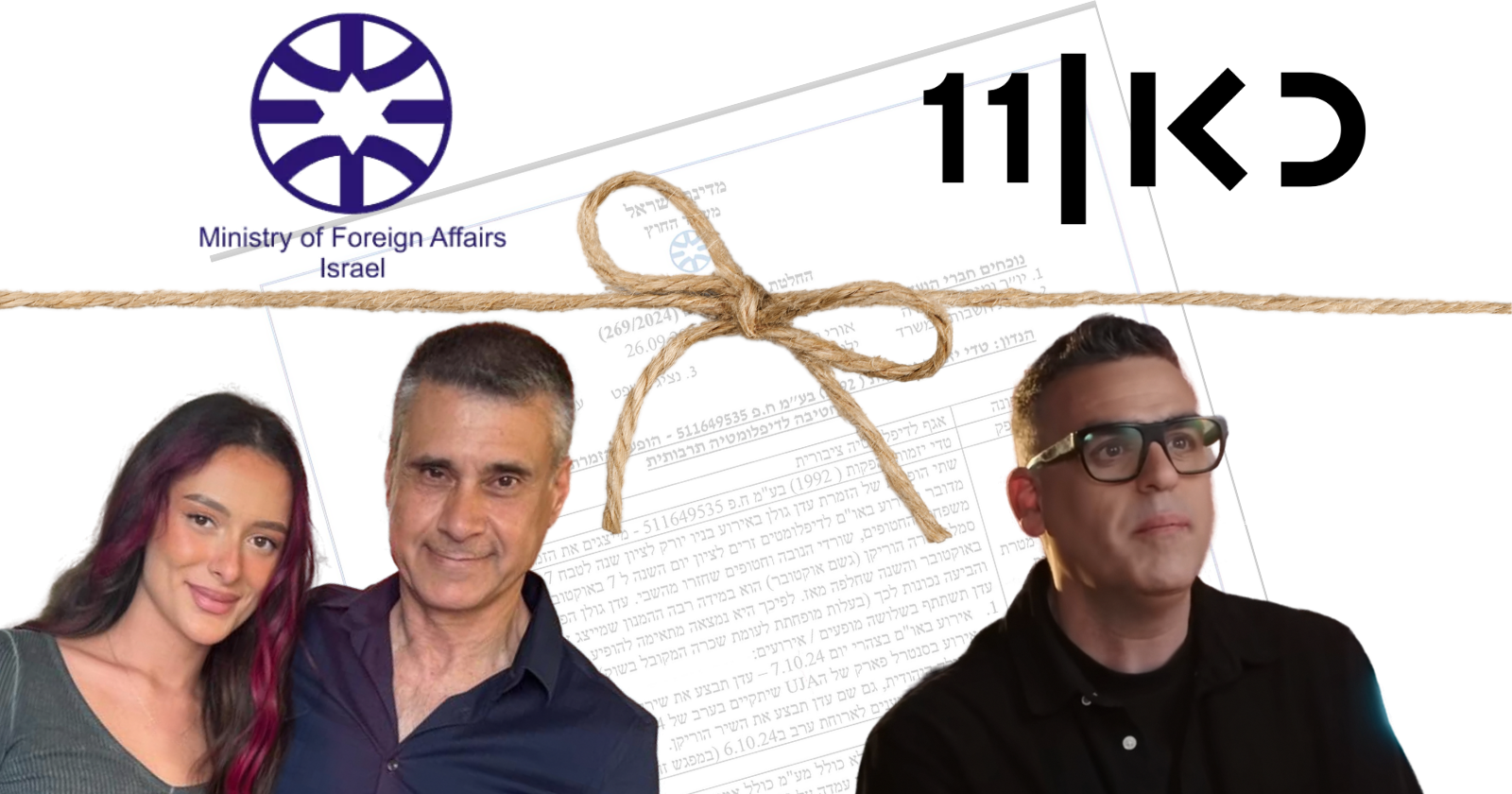
- Israel’s 2026 “voting appeal” videos featuring Noam Bettan, later banned by the EBU, were produced by the same Tel Aviv marketing company that produced the 2024 and 2025 government voting campaigns, despite EBU rule changes
- A high-ranking Ministry of Foreign Affairs official and a KAN delegation member were both present during filming of the ads in 2024
- KAN social media post about Eurovision marked the Ministry of Foreign Affairs as a “collaborator”
- Documents show the production company used by KAN was to receive ~€30k directly from the Israeli Ministry of Foreign Affairs for a propaganda performance of “October Rain”
Previous Israeli government campaigns to influence the Eurovision Song Contest televote have by now been widely reported. Investigations by YLE, The New York Times and even the EBU’s own investigative journalists have shown how paid YouTube ads were placed on behalf of the Israeli Ministry of Foreign Affairs, calling for multiple votes for Israel’s Eurovision entry.
The EBU has consistently asserted that the government campaigns did not involve the Israeli public broadcaster KAN, and that the artists who featured in government voting ads did so on their own initiative. A KAN representative told the New York Times that it had “no prior knowledge of government ad campaigns”. In an interview with NPO Nieuwsuur, Martin Green, the contest’s director, cleared KAN of any responsibility for the campaigns:
there was a particular focus on a government agency […] which I want to be very clear about, is nothing to do with the independent public broadcaster KAN.
Martin Green, Director of Eurovision. Source: NPO Niewsuur, 11th May 2026
Facing increasing pressure from other public broadcasters about previous Israeli government interference, the EBU changed the rules around how participants advertise for votes in the 2026 competition. Although the full text of the 2026 rule changes were not made available to the general public, a press release from the EBU announcing the changes stated that “participating broadcasters and artists are not permitted to actively engage in, facilitate or contribute to promotional campaigns by third parties that could influence the voting outcome”.
In 2026, a new set of voting appeal videos featuring Israeli representative Noam Bettan again appeared online, calling for viewers of the video to “Vote 10 Times” for Israel. Fan media immediately noted striking similarities between these videos, and those from the government-funded campaign in 2025.
[NOAM BETAN VOTING VIDEOS]
In a statement, the EBU said it had issued a formal warning to KAN, the Israeli public broadcaster, and that it had directed KAN to “stop any distribution of the videos and remove them from any platforms where they had been published”. The EBU added: “[rules] that cover promotion are predominantly directed at discouraging large scale funded third-party campaigns, and we are satisfied that this video did not form part of such a campaign.”
Today, nearly five months after the 2026 contest, our activist group, Eurovision Fans Against Genocide, is publishing the first of a two-part investigation into the Israeli government’s efforts to influence the Eurovision televote. In part 1, we detail three main findings:
- The banned 2026 videos featuring Noam Bettan were produced by the same Tel Aviv marketing company, Moosh Marketing, which produced videos and graphics for the 2024 and 2025 government advertising campaigns
- A high-ranking Ministry of Foreign Affairs official and a KAN delegation member were both present during filming of the 2024 videos. Further evidence from KAN’s social media posts confirm that KAN was collaborating with the Ministry of Foreign Affairs during 2025
- The production company which produces KAN’s Eurovision entry each year was due to receive money from the government for Eurovision propaganda. Tedy Productions was to receive ~€30k directly from the Ministry of Foreign Affairs in 2024, in payment for Eden Golan’s performance of “October Rain” at a government event at the United Nations to mark the anniversary of the 2023 attacks.
Our investigation raises serious questions for the EBU, which is often accused of not applying its own rules when breaches are carried out by Israel. We provided the EBU with a summary of our findings, and requested comment. No response was received prior to publication.
In part 2 of our investigation, we reveal how the voting campaign was adapted in 2026, in reaction to tightened EBU rules around government campaigns. [CHANGE - CUT? We show how the KAN delegation worked with an organisation previously linked to Israeli government social media influence operations, to spread a voting campaign on social media. Finally, we provide evidence that KAN was working directly with another third-party funded campaign to influence the vote - US pro-Israel propaganda organisation StandWithUs - in direct breach of the 2026 rules.]
2023: government multi-lingual video campaigns begin
In May 2023, David Saranga, then Director of Digital Communications at the Israeli Ministry of Foreign Affairs, posted a video to his Instagram profile. Addressing the camera is Noa Kirel, the artist who is representing Israel at Eurovision 2023 in Liverpool.
“I want to heartfully thank Guy from LAPAM, and David Saranga from the Ministry of Foreign Affairs, for all you are doing for me, for people to vote for me.”
Why was Noa Kirel thanking the Ministry of Foreign Affairs and LAPAM, the Israeli government advertising agency? The answer is still available to be found online - a paid advertising campaign on YouTube, urging votes for the Israeli entry. In the videos, shot from the same vantage point as her thank-you video to the Ministry Foreign Affairs, Kirel addresses the camera in multiple European languages - “Vote for Unicorn”; “Votad por Unicorn”; “Votate Unicorno”; “Stem op Unicorn”.
A graphic, also posted by Saranga on Instagram, showed just how successful the advertising campaign had been: 9 million YouTube views and over 5 million “interactions” with the campaign - even before the final. A logo on the top right of the graphic additionally credits LAPAM – the Israeli government advertising agency.
But this government campaign to win votes for Israel in 2023 was no secret - Israeli news outlet ynet even carried a detailed article about the campaign in Hebrew, quoting Saranga.
“The Ministry of Foreign Affairs and the advertising agency have placed an emphasis on Eurovision-loving audiences, such as the LGBTQ+ community in Europe, members of fan clubs, and opinion leaders in the field.”
*Machine translation from Hebrew to English. Source: ynet.co.il
Israel did achieve a large televote that year - coming in 5th place in the televote, with 185 points. Did the advertising campaign by LAPAM and the Ministry of Foreign Affairs have any undue influence on the result? Despite the ads reaching millions of possible voters, it seems unlikely. Eurovision’s professional juries, responsible for 50% of the final result, placed Kirel even higher than the public televote, in 2nd place, and Kirel’s song achieved relative streaming success across Europe.
But thanks to the newly re-surfaced personal “thank-you” video of Kirel above, we can say one thing for certain - the artist was fully aware, when shooting the multilingual voting appeal videos, that they were participating in a government-backed campaign, co-ordinated by the David Saranga of the Ministry of Foreign Affairs.
And these multilingual voting appeal videos would be a tactic repeated by Israel in Eurovision - every year since.
2024
On October 7th, 2023, militants from Hamas, Palestinian Islamic Jihad, and other armed groups crossed the boundary fences of Gaza. In the hours that followed, they would kill over 800 civilians, taking over 200 as hostages back into Gaza. The Israeli military responded with revenge killings, carrying out indiscriminate airstrikes on Gaza. Within weeks, the Israeli military had already killed as many civilians as the October 7th attacks, and showed no signs of stopping. Government officials openly made comments with genocidal intent.
By early 2024, the usual preparations were happening for the Eurovision Song Contest - broadcasters across Europe were busy selecting the acts and songs that would represent their countries. For the Israeli government - which even before October 7th had a keen interest in using Eurovision for what it called “public diplomacy”, the contest had taken on an even more important role.
In late February 2024, it was reported that a song called “October Rain” had been proposed by KAN, the Israeli public broadcaster – the title being a rather obvious reference to the October 7th attacks. Despite rules against songs with political references, the EBU relented to a rewrite of the song – “October Rain” became “Hurricane”. By all accounts, the Israeli side was not happy with even this level of compromise – with Israeli president Isaac Herzog having to personally intervene to urge KAN to accept the rewrite, so that the country would not face exclusion from the contest.
Across Europe, public outrage at the Israeli military’s actions was growing. By the week of the contest proper, 35,000 Palestinians had been killed in Gaza, 14,000 of them children. Eurovision was due to take place in Malmö, Sweden. Our activist group was founded to attend these protests as Eurovision fans, opposed to the participation of Israel (sadly, a minority view at the time).
And just like in 2023, David Saranga from the Ministry of Foreign Affairs was again in charge of the effort to influence the public televote in favour of Israel. During the week of the 2024 contest, reports of multilingual paid advertisements featuring the artist, Eden Golan circulated on social media.
However, the existence of the 2024 voting campaign received little attention among the wider press – with the exception of fringe website The GrayZone, which reported that many of the paid advertising videos it found had since been deleted.
Additional videos, using identical graphical styles to those posted by both KAN and official Israeli government accounts, clipped together pro-Palestinian campus protests and carried a message – “DON”T LET THEM WIN. VOTE ISRAEL”.
https://x.com/DavidSaranga/status/1788570705585476003?s=20
We won’t dive too much into the deservedly controversial 2024 contest week here - those events have been well-documented by fans and traditional media alike. Israel achieved a massive televote result - coming 2nd in the televote, with 323 points. It received just 52 points from professionally juries, pushing it into 5th place overall.
Speaking to ynet, David Saranga from the Israeli Ministry of Foreign Affairs again took full credit for the voting video campaign. Speaking to ynet, Saranga suggested the Eurovision televote represented a silent majority, and that anti-genocide protestors across Europe were largely “Muslim”:
“The gap between the jury vote and the audience vote indicates the fear of decision-makers and public office holders to adopt a pro-Israeli position. The fear is of public terror from a vocal minority, which in many cases is Muslim*” [CHECK TRANSLATION]
Source: https://www.ynet.co.il/news/article/bjjlx4jm0 [CHECK TRANSLATION]
2025 – the same formula is used again; journalists start catching on
In 2025, the EBU hoped to avoid a repeat of the tensions of the previous year. In a rule change, it allowed the audience to bring all legal flags, including the Palestinian flag. However, in the hopes of avoiding any activism on stage, it banned artists from showing anything but the official flag of their country on stage.
This edition, taking place in Basel, Switzerland, brought with it extra attention on the EBU from European media, among them, journalists themselves working for EBU member broadcasters. The question was whether Israel would again achieve a large televote. All indications pointed to Israel being more unpopular than ever - several hostage deals had not stopped the Israeli military from indiscriminately bombing Gaza, and opinion polls showed the country was even more unpopular among Europeans than during the 2024 contest. By the time of the 2025 contest, an ICC warrant for war crimes had long been issued against Israeli leaders.
Incredibly, Israel topped the televote with 297 points - but received just 60 points from the professional jury.
The reaction this time around was much less hesitant – the next day, Spain’s broadcaster RTVE requested detailed voting data from the EBU. It would be joined by Belgian broadcaster VRT, and Slovenian broadcaster RTV.
Journalists at Finnish broadcaster YLE published an investigation into that year’s Israeli voting campaign videos, identifying the Israeli government advertising agency LAPAM as the entity which paid for the advertisements on YouTube. The New York Times also ran an article on how official Israeli state accounts, posting in English, had urged the public to vote 20 times for Israel, using graphics similar to those posted in 2024.
The EBU’s own investigative outlet, Eurovision News Spotlight (which is editorially independent from the EBU) also published an investigation within days, detailing the LAPAM voting appeal video campaign on YouTube. While decidedly critical of the voting campaign, the EBU Spotlight report curiously pre-emptively exonerates KAN of direct involvement, on the grounds that no KAN attribution appears on the videos:
“The extensive promotion of Raphael, however, notably omitted any mention of KAN, the Israeli Public Broadcasting Corporation [..] indicating the broadcaster was not directly involved in the advertising campaign.”
Source: EBU Spotlight
David Saranga again took his credit for the campaign in the Israeli media [LINK].
2026 – third time lucky for the EBU?
After two editions of the contest dominated by the Israeli government instrumentalising the contest, some broadcasters had finally had enough, and demanded a vote on Israel’s participation. The EBU played, in the words of one broadcaster, a “cleverly orchestrated” vote: instead of voting on Israel, the broadcasters would
The Tel Aviv Marketing company producing “a large portion” of the Ministry of Foreign Affairs’ propaganda… and Eurovision voting ads
Moosh Marketing, a company registered in Ramat Gaman, close to Tel Aviv, lists among its many clients the Israeli Ministry of Foreign Affairs and the Ministry of Diaspora Affairs and Combatting Antisemitism. A glowing client testimonial from LAPAM, the Israeli government advertising agency, adorns the front page:
“On every project I collaborated on with Moosh, I felt I had someone reliable on the other side - someone who would refine the messaging and push for fresh ideas. We worked on a variety of projects for the Ministry of Health, the Ministry of Foreign Affairs, the Ministry of Tourism, and more… every time, the result felt spot-on and delivered amazing outcomes.”
Machine translation. Client testimonial of Eyal Varshisky, Senior Marketing Consultant - LAPAM. Source: Moosh Marketing website
This is not, by itself, remarkable. Due to the large role of the state, government contracts are common in Israel. However, an Instagram post by the company provides insight into the nature of some of Moosh’s work for LAPAM.
[https://www.instagram.com/p/C2F59wei5qx/]
“For 100 days, we’ve been proud to play a significant role in the national public diplomacy hasbara effort led by the Government Advertising Agency and to produce a large portion of the hasbara videos for the Ministry of Foreign Affairs and the Ministry of Diaspora Affairs.”
Source: Post by @moosh__marketing on Instagram
Interspliced with images of terrified civilians being taken hostage by Palestinian armed groups on October 7th, graphics in English read “136 INNOCENT ISRAELIS… 100 DAYS OF HAMAS’ BRUTAL CAPTIVITY… STAND WITH ISRAEL, STAND WITH HUMANITY.”.
The video, uploaded in January 2024, is described by Moosh Marketing as an example of a “hasbara” video the company has produced for LAPAM. The term “hasbara” is described by +972 Magazine as “essentially doublespeak for propaganda”. The caption also lists the end client of this particular propaganda video - the Israeli Ministry of Foreign Affairs.
But Moosh Marketing’s work on Israeli state interests was not limited to making government propaganda videos. Still publicly viewable at time of writing on the @moosh__marketing Instagram page are three previously unreported “behind-the-scenes” videos. The footage shows the filming of the 2024, 2025 and 2026 Eurovision voting videos later used in the government advertising campaigns.
[SIDE BY SIDE - BEHIND THE SCENES, MOOSH, 2024, 2025, 2026]
This confirms for the first time what was long suspected by fans - that the Israeli voting campaign videos were indeed produced by the same company each year - Moosh Marketing.
The behind-the-scenes videos also prove, if it were necessary, that the advertising videos formed part of a series - in the 2025 and 2026 “behind-the-scenes” videos posted by Moosh, a brief glimpse of a laptop held by film crew can be seen. While filming the voting video featuring Yuval Raphael in 2025, the staff member appears to have the 2024 video featuring Eden Golan open on their laptop, apparently as a memory aid to the current year’s production. The same is also true for the 2026 video featuring Noam Bettan – in this video, a laptop can be glimpsed with Raphael’s voting video open.
[COMPARISONS WITH LAPTOP SCREEN HIGHLIGHTING CONTINUITY FROM 2024, 2025, 2026]
What remains unclear, is who may have commissioned Moosh Marketing to produce this video ad campaign series, three years in a row. We asked this question among others in an email sent to the CEO of the company, Moshiko Vaizman, who can be seen in each of the videos. We did not receive a reply prior to publication.
Several weeks after discovering the Moosh Marketing videos, our investigation stumbled across another clue. In a post dated 9th May 2024 on his Instagram account, David Saranga, from the Israeli Ministry of Foreign Affairs, can be seen posing with Eden Golan, against an industrial white background.
Comparing the photo with the 2024 Moosh Marketing video frame-by-frame, we were able to match the white industrial piping and brick with the studio where Moosh Marketing filmed the 2024 ad campaign. From this, we can conclude that Saranga was present with Eden Golan, in the studio where the ads were filmed.
[Side by side - Saranga and freeze frame]
There is reason to believe the picture of Saranga and Eden Golan was taken around the time of the ad shoot - the very same day as posting the picture, Saranga also posted a copy of the video advertisement to Instagram. We asked the Israeli Ministry of Foreign Affairs and a press representative for Ambassador David Saranga for an explanation of this photo - however as of time of publication we had not received any response.
However, Moosh’s 2024 behind-the-scenes video with Eden Golan contains yet another revelation about the parties that were present during filming. For just one second, a man with distinctive glasses can be seen, sitting on a couch in the background – this is Sivan Young, a KAN Eurovision delegation member.
[Figure text]
“You’re also behind the scenes, managing the voting operation a bit”
Sivan Young is a long-standing member of the KAN Eurovision delegation. He has been present as an Israel delegation member for at least [EIGHT - 2015, 2016, 2017, 2018, 2019, 2024, 2025, 2026] editions of the contest - including in 2024, 2025 and 2026. He can be seen in the broadcast itself during the voting sequences, usually seated next to the Israeli artist. He is described in some interviews with Israeli media as the “Artistic Producer” of Israel’s Eurovision entry, in others simply as a “Senior Member” of the Israeli delegation. KAN did not respond to specific questions about Young’s role in the delegation.
Figures L-R: Still captures from the 2024, 2025 and 2026 Eurovision Song Contest broadcasts show Sivan Young (highlighted), member of the KAN delegation.
Young is also interviewed in a KAN documentary about Israel’s contentious appearance in Malmö 2024 - in the documentary, he is identified by KAN as an employee of Tedy Productions. Tedy Productions is the producer of HaKokhav HaBa - “The Next Star”, the preselection contest that chooses KAN’s Eurovision entry. The show is described by the Jerusalem Post as a “partnership between KAN, Keshet, and Tedy Productions”.
[Figure description]
In a KAN Eurovision podcast from January 2026, Young describes his own role in the Israeli Eurovision delegation in detail. Pre-selection, he “conducts the preliminary auditions” in his role as artistic producer of “The Next Star”, while at Eurovision “it’s about producing the Eurovision act”.
“There’s no Eurovision delegation without him”, one of the KAN hosts quips. “You’re the beating heart of the event”, says another.
Later, the hosts of the interview move on. “You’re also behind the scenes, managing the voting operation a bit, as we’ve seen.” “-As your lawyer, Sivan, I suggest being careful here”, a host playfully interjects. “We’re saying this because in Europe right now, people are paying very, very close attention to everything; they’re very sensitive to voter mobilisation”. The hosts later joke that Mossad has successfully manipulated the Eurovision vote.
“Jewish communities reach out to us and ask for a photo of Noam to promote him, and that’s legitimate and legal”, Young says. “It’s permissible to promote the artist, it’s permissible to send photos”.
We sent a list of questions to Sivan Young’s employer, Tedy Productions and an email address associated with Young. No response was received prior to publication.
€30k payment from the Ministry of Foreign Affairs - for a performance of “October Rain” at the United Nations
Tedy Productions, which produces Israel’s Eurovision act on behalf of KAN (and which we understand employs both Sivan Young and one other KAN Eurovision delegation member), also has a more direct link to the Israeli Ministry of Foreign Affairs and Eurovision propaganda.
On 7th October 2024, the anniversary of the October 7th attacks, Eden Golan performed the version of “Hurricane” that the EBU had banned - “October Rain”, at an event at the United Nations in New York. David Saranga appears in an Instagram video promoting the event, posted on the @stateofisrael Instagram account.
[EMBED of the performance]
Publicly available tender documents, reported here for the first time, show that Tedy Productions, was due to receive a payment of ca. €30k for this performance by Eden Golan. The payment, which is marked in the tender document as approved, was to come from the Israeli Ministry of Foreign Affairs. For the first time, the Ministry of Foreign Affairs document explicitly asserts that the lyrics of October Rain “represents the events of October 7th”.
Figures L-R: A public tender document in Hebrew showing Tedy Productions was due to receive 99,450 ILS (ca. €30k) from the Ministry of Foreign Affairs for a propaganda performance of October Rain at the UN; a machine translation of the document
We sent detailed questions to KAN and Tedy Productions about the nature of any payments from the Ministry of Foreign Affairs to Tedy Productions. No reply was received prior to publication. Confirmation of KAN collaboration with Ministry of Foreign Affairs on Eurovision
However, proof that KAN was directly collaborating with the Ministry of Foreign Affairs on Eurovision in the past few years is actually much more readily available.
In a post sharing a video of Yuval Raphael’s performance in 2025, the KAN Instagram page listed a number of “collaborators” - the song’s composer, another KAN account - and two others: 4ILorg, and StandWithUs.
StandWithUs is a well-known pro-Israel organisation based in the US, which works closely with the Ministry of Foreign Affairs on several initiatives, among them a program to train college students in pro-Israel “public diplomacy”, which is hosted by the Ministry itself.
4IL, on the other hand, is itself a direct propaganda initiative by the Ministry of Foreign Affairs, with a government webpage: https://4il.mfa.gov.il/index.php/ . Historically based under another Ministry, the 4IL program exists to manipulate public perception of the State of Israel online. It did this by directing users to install an app called Act.IL (now defunct), which tasked an army of pro-Israel volunteers to vote in surveys about Israel, comment under news articles about Israel, and upvote particular comments.
https://www.youtube.com/watch?v=HxKrn8Aqa0A [START FROM later]
The online campaigns to influence Eurovision, run by both the government-aligned StandWithUs organisation, and the Israeli government directly via 4IL are the subject of part 2 of our investigation.
Instagram’s collaborators feature, in contrast to “tagging”, requires the collaborating account to manually accept the collaboration request for an individual post. The feature instantly distributes the posts to followers of the collaborator accounts. We asked both KAN and the Ministry of Foreign Affairs to explain why the 4IL account accepted a collaboration request from KAN on the video of Yuval Raphael’s performance, but did not receive any response.
Comment
Our investigation proves that Eurovision fans were correct to be skeptical of KAN’s claimed lack of knowledge of the government advertising campaign. It shines a light on the depth of collaboration by KAN with the Netanyahu government in the aftermath of October 7th, and shows how KAN and the government had a shared view of Eurovision as a national unity project.
It challenges the prevalent but false assumption among some European public service broadcasters - that KAN somehow opposes the killing in Gaza. The reality is [LINK TO STUARTS VID].
The 2026 was described by some commentators as a make-or-break year for the EBU. Indeed, Martin Green, director of the contest, said as much:
“Obviously I would like all 5 of them to come back […] it’s up to us to see if we can persuade them that some of their concerns have been met, and a lot of that we can only demonstrate through this show.”
The revelation that the voting campaign appears to have continued in 2026 - with the same marketing company involved as the previous government campaigns in 2024 and 2026, will do little to comfort broadcaster concerns about Israeli government interference in the contest. The involvement of the supposedly independent broadcaster KAN in government influence campaigns around Eurovision confronts member broadcasters with a choice - to continue allowing their contest to be instrumentalised, or to finally enforce their own rules.
We contacted the EBU’s Eurovision press contact requesting comment on the key allegations in this article, and posed a number of specific questions for the EBU and Martin Green. No response was received, and a follow-up phone call to the EBU’s Geneva office was not returned. We additionally contacted several elected members of the ESC Reference Group, which governs aspects of the contest, but did not receive any substantial response.
KAN, Sivan Young, and Tedy Productions did not respond to email requests for comments on the allegations in this article.
Press contacts at the Israeli Ministry of Foreign Affairs did not respond to requests for comment. No response was received to an email to the press attaché of the Israeli embassy in Brussels with questions for Ambassador David Saranga.
This investigation was carried out in our free time over the last months by Eurovision Fans Against Genocide. If you’ve read this far, we would ask you if you are able to make a small donation to our fundraiser for Medical Aid for Palestinians (MAP) via our JustGiving page. MAP is a registered UK charity, number 1045315.
Want to know when Part 2 is published? Join our mailing list